Views: 0 Author: Site Editor Publish Time: 2026-09-24 Origin: Site
Managing mixed-temperature orders creates massive friction for kitchen operators and delivery drivers. Grouping hot meals and iced beverages together guarantees degraded food quality. Thermal energy transfers rapidly between items, melting desserts and turning hot entrees cold. Condensation builds up, creating soggy packaging that collapses before it reaches the customer's door. Poor temperature management leads to steep financial losses, negative reviews, and potential health code violations when holding temperatures drop below safe thresholds. Solving this requires a systematic, operations-first approach. Relying on standard paper bags fails every time. Operators must evaluate in-house staging protocols and implement specialized packaging designed for thermal isolation. Upgrading to purpose-built delivery equipment prevents heat transfer entirely. Implementing these structural changes protects food integrity from the prep counter to the final drop-off. Effective hot and cold food delivery demands precision, physical barriers, and clear handling procedures.
Strict Thermal Isolation is Mandatory: Relying on ambient air gaps within a single bag is insufficient; physical thermal barriers are required to prevent rapid heat transfer between hot and cold items.
Staging Dictates Delivery Success: Implementing dedicated holding equipment (heated and refrigerated zones) prior to driver handoff is as critical as the delivery transport itself.
Equipment Selection Requires Nuance: Choosing the right delivery bag for hot food and drinks involves evaluating insulation density, modular dividers, and ventilation capabilities to balance temperature retention with moisture control.
SOPs Drive Consistency: Standardizing the packing process and establishing clear handling guidelines for couriers—including vehicle-level logistics—mitigates the risk of human error during transit.
Table of Contents
The USDA 2-Hour Rule states that prepared food should not stay at room temperature for more than two hours, or one hour when temperatures exceed 90°F. The food Danger Zone is between 40°F and 140°F, where bacteria can grow quickly. During staging and delivery, hot food should stay above 140°F and cold food below 40°F. Proper temperature control and physical separation help reduce food safety risks during delivery.
When hot food and cold drinks are packed together, heat naturally moves from the warmer food toward the colder items. This can cool the meal and melt ice in drinks. Hot food also releases steam, which can create condensation inside a sealed bag and make fries, paper bags, and cardboard boxes soggy. Separating hot and cold items, using insulated barriers, and adding ventilation to the hot compartment can help reduce these problems.
Staging mixed orders on standard prep counters guarantees failure. Ambient shelving exposes food to room temperatures immediately. Hot items begin cooling the second they leave the pass. Cold items start sweating on the counter, creating puddles that ruin paper bags. Standard metal racks offer no thermal support and actually conduct heat away from hot packages. Relying on ambient staging forces couriers to transport already-degraded food. This practice directly inflates refund rates and generates negative reviews.
Investing in specialized staging equipment provides a measurable return. Heated shelves maintain hot food above 140°F while waiting for driver assignment. Refrigerated holding units keep beverages and desserts chilled. Ambient lockers secure dry goods safely. Comparing the equipment investment against the cost of refunded orders reveals a clear operational advantage. Proper staging preserves the thermal baseline before the courier even arrives at the restaurant.
Implementing dual-zone staging requires careful spatial planning. High-volume kitchens face strict footprint constraints. Vertical space must be utilized effectively to maximize throughput. Wall-mounted heated shelves save valuable counter space. Undercounter refrigeration keeps cold items accessible but out of the way of the main line. The staging area must accommodate rapid handoffs while maintaining strict thermal separation.
Staging Equipment Type | Thermal Retention Capability | Footprint Impact | Ideal Application |
|---|---|---|---|
Standard Metal Wire Racks | None (Accelerates heat loss) | High (Takes up floor space) | Dry goods, napkins, utensils only |
Heated Pass-Through Shelves | Excellent (Maintains >140°F) | Moderate (Can be wall-mounted) | Pizzas, hot entrees, fried foods |
Undercounter Refrigeration | Excellent (Maintains <40°F) | Low (Fits under prep tables) | Salads, iced beverages, desserts |
Smart Ambient Lockers | Low (Protects from drafts) | High (Requires dedicated wall) | Secure handoffs for room-temp items |
Synchronizing the completion of hot and cold items prevents premature degradation. Dwell time is the enemy of food quality. The expeditor must coordinate the kitchen line and the beverage station effectively. If a hot sandwich sits waiting for a milkshake, quality drops. If the milkshake melts while waiting for fries, the order fails. Minimizing dwell time requires precise ticket management and Kitchen Display System (KDS) routing.
Delaying cold item preparation improves outcomes significantly. Expeditors should hold off on pouring fountain drinks until the driver is three minutes away. Desserts should remain in the freezer until the final bag is sealed. Staff should only finalize these items when the courier physically arrives at the pickup window. This strategy maximizes the thermal runway for cold goods during transit.
Balancing speed of service with temperature retention requires operational trade-offs. Pouring drinks early speeds up the handoff process. However, it sacrifices optimal temperature retention and leads to melted ice. Delaying the pour adds seconds to the courier interaction. Yet, it guarantees a superior product upon delivery. Expeditors must prioritize food integrity over fractional time savings at the staging counter.
Putting hot food and cold drinks in the same sealed bag can quickly reduce food quality. Cold drinks absorb heat from nearby meals, while heavy cans or cups may crush food containers during transport. Sealed bags can also trap steam, causing condensation and soggy packaging. Because drivers usually cannot open sealed orders to separate the items, these packaging problems may lead to cold food, melted drinks, customer complaints, and refunds.
Different packaging materials provide different levels of temperature protection. Paper bags offer little insulation, while corrugated cardboard and foil-lined sleeves can slow heat loss. Insulated cup carriers help keep cold drinks away from hot food, and containers with built-in dividers can separate foods with different temperature needs. For longer deliveries, using insulated barriers and separate compartments helps maintain food quality and protect packaging from heat and moisture.
Packaging Material | Thermal Resistance | Moisture Tolerance | Best Use Case |
|---|---|---|---|
Standard Paper Bag | Very Low | Poor (Tears easily when wet) | Dry, ambient items only |
Corrugated Cardboard | Moderate | Moderate (Softens over time) | Pizza, large hot entrees |
Foil-Lined Sleeves | High (Reflective barrier) | Excellent (Blocks grease and water) | Hot sandwiches, wraps, burritos |
Molded Pulp Carriers | Low | Good (Absorbs slight moisture) | Cold beverage transport |
Vented Polypropylene | Moderate | Excellent (Waterproof) | Fried foods requiring steam release |
Secure beverage packaging is non-negotiable for mixed orders. Cold liquids spilling onto hot food containers ruins the entire delivery. Restaurants must utilize tight-fitting lids on all cups. Tamper-evident seals placed over straw holes prevent leaks from sloshing during transit. Sturdy cup trays keep drinks upright during sharp vehicle turns. Spill prevention maintains the structural integrity of the surrounding packaging and protects the hot food.
Physical separation remains the best strategy for operators. Staff should pack hot and cold items in completely separate bags. To keep the order logically grouped for the driver, staff can knot the handles together. Alternatively, heavy-duty branded stickers can connect the bags. This ensures the courier takes the complete order. It achieves logical grouping without forcing physical thermal consolidation.
Selecting the right transport equipment defines the delivery phase. Operators must choose between a single dual-zone bag or a multi-bag system. A dual-zone delivery bag for hot food and drinks features insulated internal dividers. It allows one bag to carry both temperature zones safely. A multi-bag system uses one dedicated hot bag and one dedicated cold bag for complete isolation.
Operational efficiency varies between the two approaches. Dual-zone bags streamline the courier's movement from the vehicle to the door. The driver only carries one item, keeping a hand free for navigation or opening gates. Multi-bag systems offer superior thermal isolation because the environments never share a zipper. However, they require the driver to juggle multiple items, increasing drop-off times.
Scalability depends on the fleet type and vehicle. Independent couriers prefer dual-zone bags for convenience and speed. Managed delivery fleets often mandate multi-bag systems for strict quality control. Space constraints dictate equipment choices in urban environments. Couriers on bicycles or scooters lack cargo space. A compact, dual-zone backpack is essential for two-wheel logistics where carrying multiple bags is impossible.
Good insulation helps a delivery bag maintain food temperature during transport. Common materials include EPE foam, polyurethane, and aluminum foil lining. EPE foam provides insulation and structural support, while polyurethane helps reduce heat transfer. Reflective aluminum foil helps keep heat inside the hot compartment and is easy to clean after spills. Insulation thickness also matters, as thicker, high-density foam generally provides better temperature protection and helps keep the bag and internal dividers in shape.
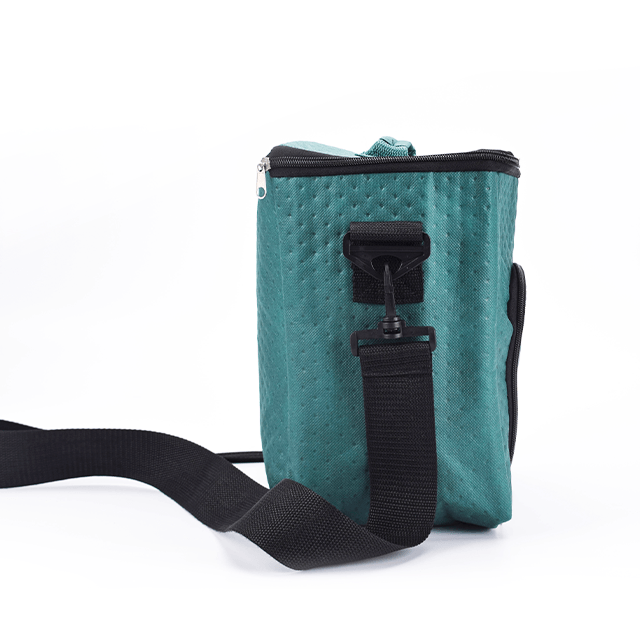
A practical delivery bag should include removable dividers, secure cup holders, and ventilation for hot food. Adjustable dividers help separate hot and cold items while keeping different order sizes stable during transport. Cup holders reduce spills and keep cold drinks away from hot food. Ventilation in the hot compartment allows steam to escape, helping reduce condensation and soggy packaging, while the cold compartment should remain well sealed to retain chilled air.
Couriers should keep hot and cold items separated from pickup to delivery. Hot food should go into the ventilated hot compartment, while cold drinks should stay secure in cup holders inside the cold zone. Adjustable dividers can prevent items from moving during transit. Drivers should also limit how often they open the bag and avoid unnecessary stops. Restaurants can support this process by providing clear pickup instructions and requiring insulated delivery bags whenever possible.
Restaurants should monitor customer reviews, refund rates, and complaints related to cold food, melted drinks, soggy fries, or spills. Delivery temperatures can also be checked when needed to identify problems with staging, packaging, or driver handling. If the same issue appears repeatedly, restaurants should adjust the relevant equipment or process, such as improving ventilation, upgrading cup holders, or using stronger insulated packaging.
Audit the expeditor station immediately to eliminate ambient holding times for cold beverages and desserts.
Upgrade primary packaging to moisture-resistant, compartmentalized containers that withstand heavy condensation.
Procure dual-zone delivery bags featuring high-density closed-cell foam and adjustable steam ventilation.
Train kitchen staff to physically separate and label hot and cold items before handing them to the courier.
Establish strict pickup policies requiring all third-party drivers to utilize insulated transport equipment.
A: They should never be stored in the same ambient compartment. According to the USDA 2-hour rule, food enters the Danger Zone (40°F to 140°F) rapidly without thermal barriers. Mixing them accelerates this degradation. Proper physical separation is required immediately upon packing to maintain safe holding temperatures.
A: Major chains prioritize order consolidation and drive-thru speed over optimal temperature retention. Sealing everything in one bag speeds up the handoff. However, this ruins food quality, accelerates heat transfer, and forces couriers to absorb negative customer ratings for melted drinks and cold burgers.
A: You must utilize adjustable ventilation in the hot zone of the delivery bag. Allowing steam to escape prevents moisture buildup that destroys paper packaging. Additionally, strict physical separation from cold items stops the temperature clash that causes heavy condensation in the first place.
A: Yes, when constructed properly. High-density EPE or polyurethane foam dividers block conductive heat transfer between the compartments. Aluminum foil linings reflect radiant heat back toward the hot food. These materials effectively slow thermal exchange, maintaining distinct micro-climates within a single bag.
A: Yes, this is the industry best practice. To ensure the courier takes the complete order, use grouped ticketing, heavy-duty branded stickers, or knot the bag handles together. This keeps the order logically grouped for the driver without causing physical thermal consolidation.
A: The most effective bags use high-density EPE foam or polyurethane for core insulation. Interiors should feature reflective aluminum foil to manage radiant heat and allow for easy sanitization. Exteriors require commercial-grade vinyl or nylon for weather resistance and long-term durability.
A: Liability is shared, but the root cause is typically restaurant-level packaging consolidation. While drivers often take the rating hit on delivery apps, the kitchen is responsible for failing to provide adequate thermal barriers and physical separation before the handoff occurs.